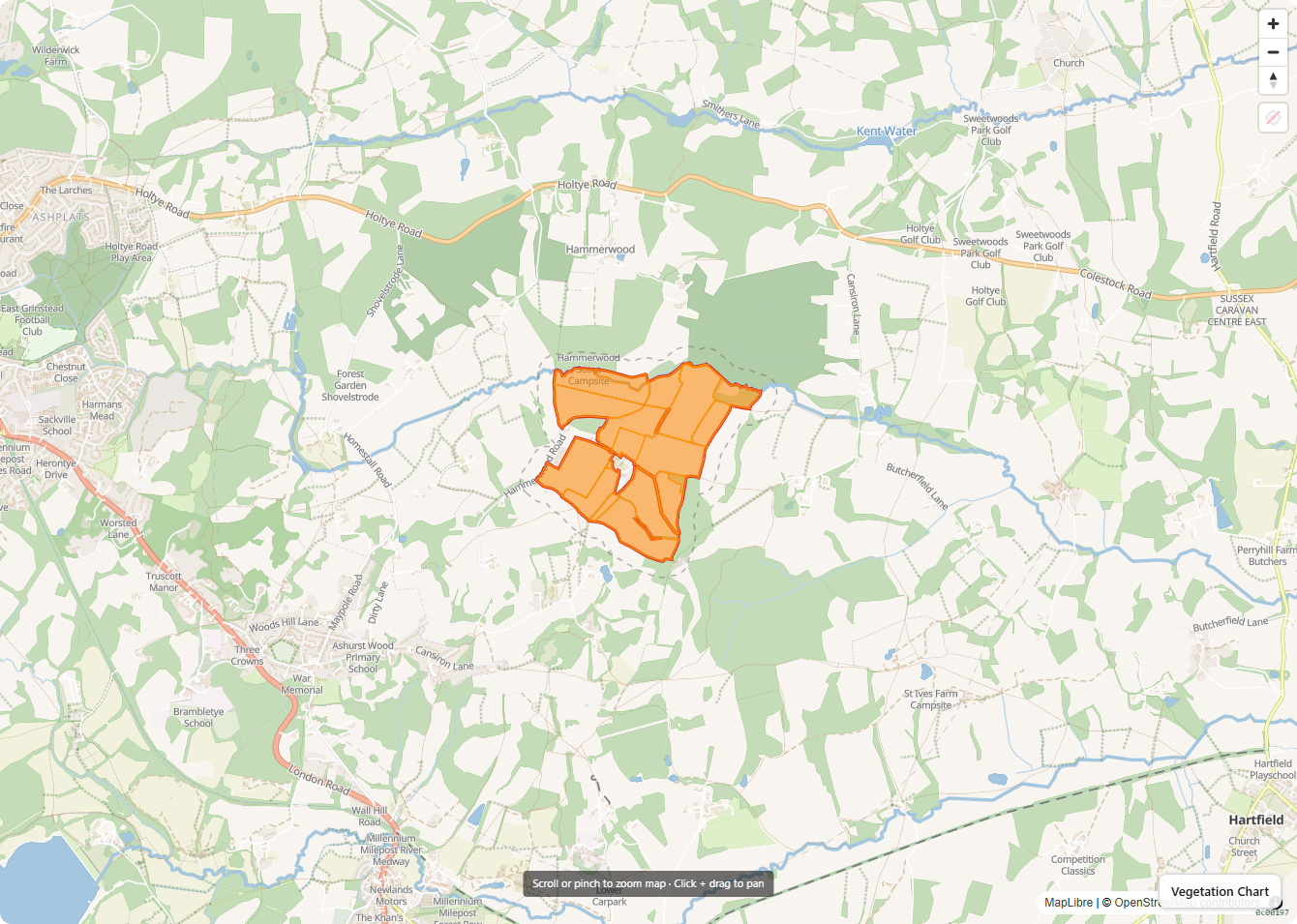
What it does
- Landsat archive back to 1984 — forty years of usable historical baseline imagery
- Current Sentinel-2 optical and Sentinel-1 radar
- NDVI, EVI, and a range of vegetation and water indices, computed and rendered as map tiles
- Soil moisture and surface water proxies
- Change-over-time comparison: any two dates side-by-side or as a difference layer
- Time-series for any point or polygon you draw
Why it matters
Long-arc evidence is the load-bearing half of ecological reporting — "this grassland was species-rich in 1990 and is now not" is a different conversation from "this grassland looks degraded today". For 30-year management agreements, BNG stewardship-proof, and Landscape Recovery baselines, the Landsat archive going back to 1984 is the structural foundation. Forty years of usable imagery, tiled, on your map.
Example
A consultant baselining a 220-hectare estate stacks five years of late-summer NDVI maxima over the historical Landsat archive, and spots a 12-hectare patch of declining grassland that the eyeball-on-the-map workflow would have missed. The historical layer becomes the evidence base for a Countryside Stewardship grassland-restoration option.